-
Autonomous Robots
Autonomous Robots

Case Study | Enhancing Heavy-Duty Intralogistics with Autonomous Forklifts in Heavy Machinery Manufacturing
 Video
Video
Case Introduction
When it comes to industrial vehicles, conventional trucks already feel massive—until you encounter ultra-large dump trucks used in heavy machinery manufacturing.

Behind these industrial giants lies an equally powerful and intelligent manufacturing system.
In this project, we worked with a long-established heavy machinery group based in Taiyuan to upgrade its in-plant logistics with intelligent automation.
The customer is a well-established heavy machinery manufacturing group with multiple production plants. Its products are exported to more than 60 countries and regions worldwide, making it a globally competitive manufacturer of advanced industrial equipment.
As production capacity continued to expand, the customer sought to modernize its internal logistics operations to improve safety, efficiency, and management transparency.
To address growing demands for heavy-load material handling, the customer partnered with Multiway Robotics to deploy a flexible, autonomous forklift solution.
The goal was to replace manual transport with safer, more efficient unmanned logistics across the factory floor.
High labor intensity and safety risks
Materials are heavy and bulky, making manual handling physically demanding and potentially hazardous.
Low operational efficiency
Unclear logistics boundaries and overlapping transport routes led to repetitive movements and detours.
Lack of unified planning and visibility
Disconnected systems limited information sharing, resulting in poor coordination and low transparency of material data.
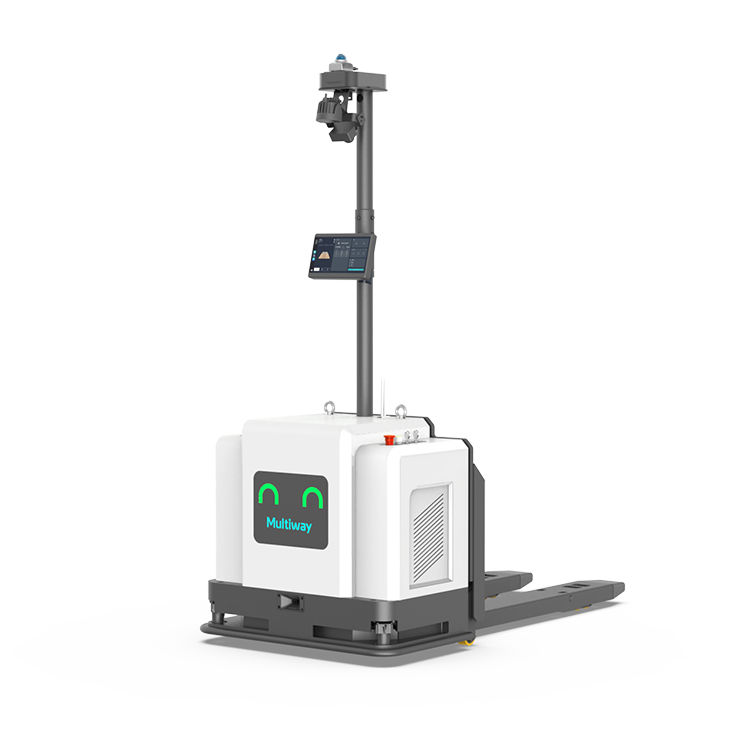
Multiway Robotics deployed an intelligent in-plant logistics system centered on the MW-SE20 counterbalance autonomous forklift.
The solution enables full-process automation, including:
Empty frame delivery to production lines
In-process material transfer
Finished material storage in the warehouse
All material movements are completed autonomously, without manual intervention.

In single-lane, two-way traffic scenarios, the RCS scheduling system dynamically manages traffic flow. Autonomous forklifts intelligently yield and reroute, preventing congestion and deadlocks.
In complex environments where pedestrians and vehicles operate together, the forklift’s LiDAR-based obstacle avoidance system continuously calculates distances, adjusts speed, and autonomously avoids obstacles.
A 2D visualization interface displays real-time inventory distribution and storage status. Operators can manually intervene when needed, achieving transparent and visualized material management.

The flexible in-plant logistics solution connects equipment flow and data flow across the entire facility.
Multiway Robotics’ self-developed WCS (Warehouse Control System) centrally manages upstream and downstream equipment, integrating seamlessly with systems such as scrap briquetting machines and PAD terminals.
The RCS scheduling system autonomously plans optimal routes and enables efficient multi-vehicle collaboration, supporting 24/7 continuous production.
Through integrated software and hardware delivery, the solution meets heavy-load handling requirements while reducing labor dependency and significantly improving inbound and outbound logistics efficiency—maximizing overall economic value and supporting digitalized operations management.
To date, Multiway Robotics has served over 500 enterprise customers, delivering solutions across more than 40 industries, including food, pharmaceuticals, new energy, automotive, machinery manufacturing, and cold chain logistics.

Offices
United States ● Atlanta l Germany ● Duisburg
Korea ● Seoul l Japan ● Tokyo l China ● Shenzhen
Tel: +86-133-9286-4873
Email: sales@mw-robot.com


Message